)
)
Johannesburg: South Africa’s Economic and Migratory Hub
)
)
The movement of people has been at the heart of South Africa’s economic story from the very beginning. Due to its strategic position on the southern tip of the African continent, Dutch, English and Portuguese settlers all made their way to South Africa, establishing lucrative commercial trading routes with their home nations. Yet, it is the intra-African migration that followed that has had a far more profound impact on the rainbow nation.
In the last 75 years, the Johannesburg-Pretoria urban area has turned into a metropolis of more than 14 million inhabitants and South Africa’s GDP per capita has increased six-fold. These advances in living standards have propelled the area to one of regional importance, with well-trodden migration routes from Lesotho, Zimbabwe and Mozambique. South Africa’s capital is now home to 26% of the country’s population, although it occupies just 1.5% of the total land mass.
In this post, we’ll explore the rise of South Africa’s economic hub, the contribution migrants make, and the critical economic role this urban area plays in the lives of people across Sub-Saharan Africa.
“City of Gold”
Originally, the area that is now known as a prosperous megacity appeared to be destined for little besides farming. Everything changed with the discovery of gold in the late 19th century; this brought not only wealth to the area but also labor-seeking migrants from all over sub-Saharan Africa. Within 10 years of the beginning of this gold rush, Johannesburg had a population of 100,000 and had earned the nickname “city of gold”, or Gauteng in Sotho-Tswana languages, a name which became official in 1994. Its proximity to Botswana, Zimbabwe, Mozambique, Eswatini and Lesotho gave the province the ideal migration conditions, which could provide the workforce needed to take full advantage of its newfound underground riches. As a result, in 1914 South Africa became the world’s leading producer of gold.
Throughout the following five decades, the number of migrants arriving in the area fluctuated with gold and diamond prices. The boom years for miners in South Africa were so lucrative that earnings from a single gold miner could support as many as 10 dependents in Lesotho. Diversification to other metals and minerals like manganese and platinum meant that by 1985, earnings from other metals and materials had nearly reached the level of earnings from gold, and the country’s position as a major producer of some of earth’s most needed commodities was further solidified.
Modern Johannesburg
The wider Johannesburg-Pretoria urban area is home to Africa’s biggest stock exchange, the seat of the nation’s executive power, and some of the best universities on the continent. This success has helped position South Africa as a vibrant regional power with a leading role in international programs like the Southern African Development Community (SADC). Migration corridors forged with Zimbabwe, Mozambique, and Lesotho laid the foundations for these international agreements, and today these countries are still the birthplaces of most migrant workers in South Africa.
However, with gold mining declining in importance, migrants have dispersed into a variety of sectors. Finance (24%) is now the biggest sector of the South African economy, with the rainbow nation attracting high-skilled labor in financial services from across Southern Africa. Combined, trade and services make up a further 30% of GDP with more traditional sectors such as manufacturing and mining accounting for 21%. Interestingly, the fastest growing sectors are those with a historically higher representation of migrant workers, agriculture, construction, and transport.
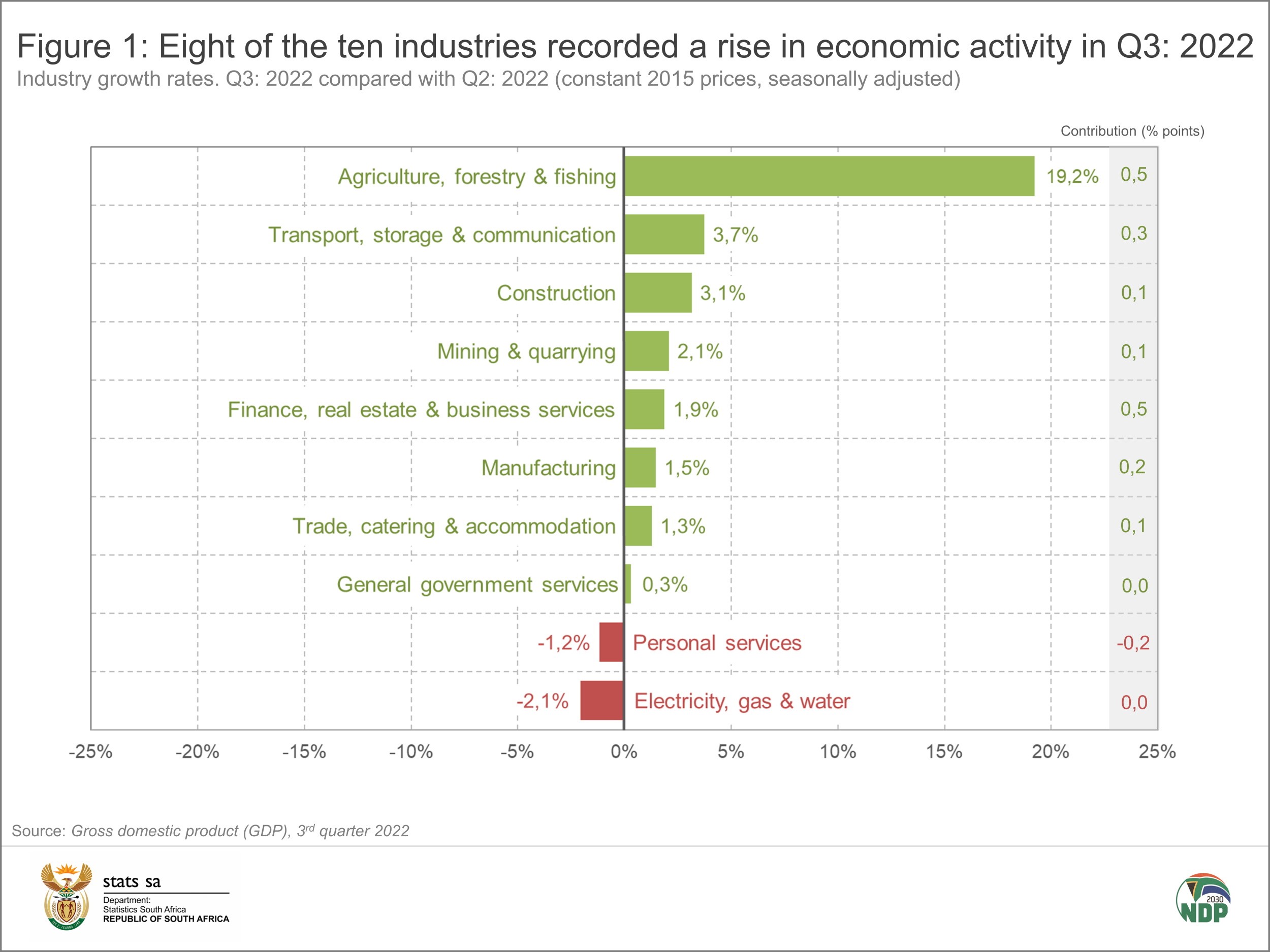
Greater Johannesburg boasts employment in all of these sectors, acting as a magnet for both skilled and unskilled labor-seeking migrants. In fact, almost half of South Africa’s international migrants between 2016 and 2021 (47.5%) came to the Gauteng province. While not all come for the region’s employment opportunities, it is clear that Johannesburg’s position as the wealthiest city in the country is a major “pull” factor.
The region’s future
Johannesburg’s medium to long-term future will be one of greater involvement in international supply chains and transition to smaller sustainable urban metropolises. In 2021, the South African government announced its plan to create two new “smart cities” in the region: Mooikloof and Lanseria. To complete construction and furnishing by 2030 and 2045 respectively, the region will need the full capacity of its construction sector, the sector with largest representation of migrant workers.
In addition to major construction projects, the fight against climate change will also increase demand for the region’s resources. With interest in green energy sources growing around the world, certain raw materials are becoming increasingly important for their role in developing renewable energy infrastructure. Gauteng is a leading source of platinum, a critical resource for the fuel cells and electrolysers used in electric cars and other “green” technologies. The province is also an important global supplier of uranium, which serves as fuel in many of the world’s nuclear energy plants.
South Africa’s role in the remittance market
New demand in the construction and resource mining industries could expand opportunities for those looking to migrate to South Africa for work. Already the largest remittance sending market in Africa, the nation could see that role continue to grow in the coming years.
Currently, remittances account for more than 10% of Zimbabwe’s economy, an incredible 25.7% in Lesotho, and between 2016 and 2021 the percentage of GDP accounted for by remittances in Mozambique more than tripled. These funds make a huge difference for families in critical areas like healthcare, food and education. Given almost half of all migrants in South Africa head to the Gauteng province, the region has become a critical remittance hub for the African continent.
To ease and facilitate these crucial intra-African remittance flows, Ria has expanded its presence in South Africa with the acquisition of Sikhona, one of the region’s leading money transfer operators. Learn more about how this will help us better serve our customers and expand access to financial products in the region in our press release covering the acquisition.
For more info: comms@riamoneytransfer.com
About the author

Matthew Breakell
Originally from the United Kingdom, Matthew Breakell is an experienced content creator specializing in the importance and impact of international remittance flows.
Related posts

ITIN vs SSN: What's the Difference and Which Do You Need?
An ITIN and an SSN aren't interchangeable, even though both let you file US taxes. Here's what separates them and which one applies to you.

What Is an ITIN and Do You Need One?
An ITIN lets you file US taxes and open many bank accounts without a Social Security number. Here's who needs one, what it does, and what it costs.

Living in Japan as a Foreigner: How to Read the Room and Feel at Home
Japan always leaves a strong impression on those who visit the country. Its cities are clean and efficient, public transport is known to be reliable, and everyday life often feels remarkably organized. These factors make it easy to understand why so many people choose moving to Japan as a foreigner: to live, work or study
The Currency of Caring: The Human Side of Remittances
Every year on June 16th, the world observes International Day of Family Remittances. On that date, we recognize the millions of migrants who send money back home to support their loved ones, helping build a better future for countless households across the globe. Although there is a lot of data about the financial impact and []